Public library of documented AI use in logistics
AI & Freight
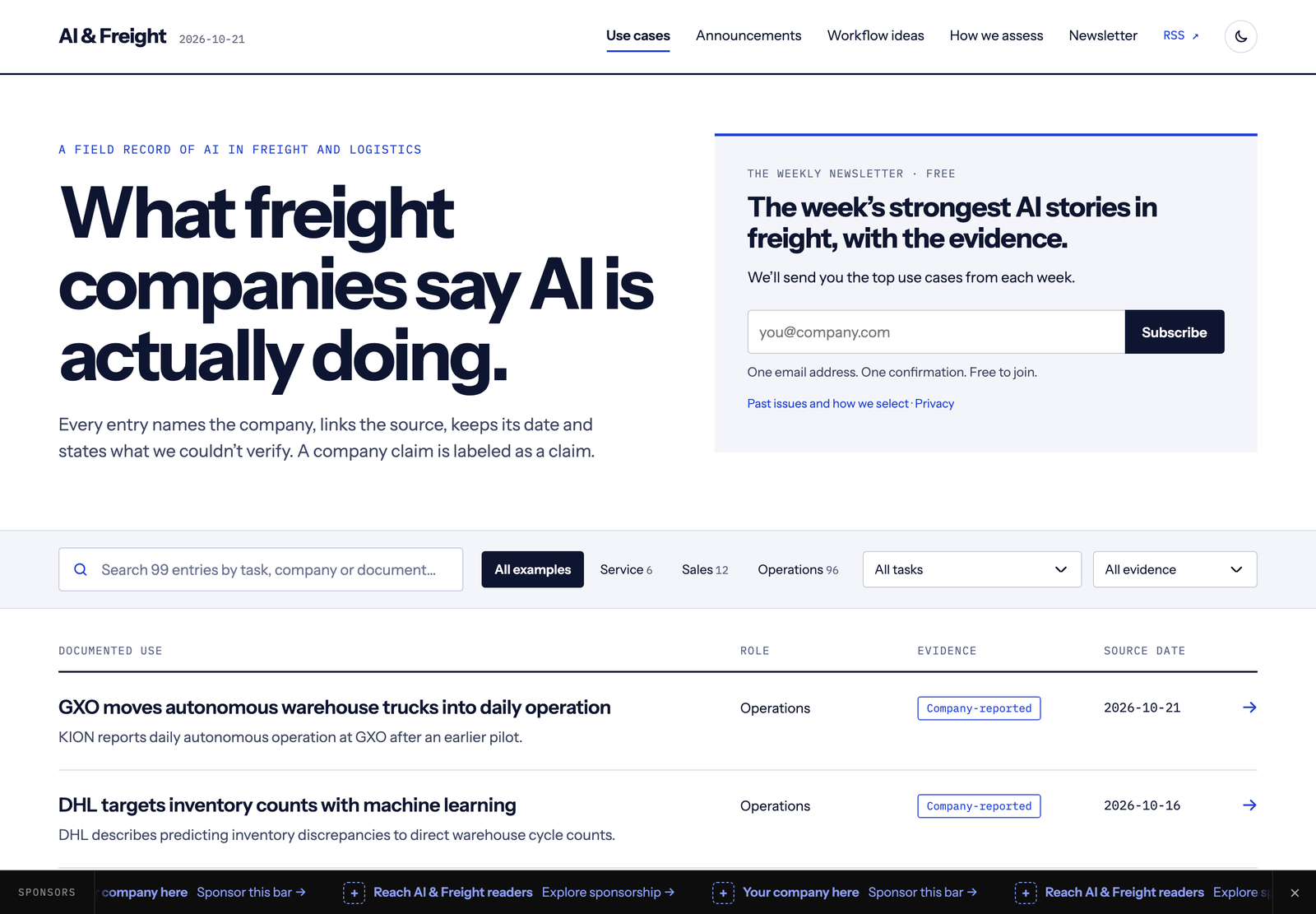
A free, no-login site that records how freight and logistics companies report using AI, with the strength of each source labelled.
The problem
AI claims in logistics blur vendor marketing, company statements and tested results. Readers need to see which is which.
My role
Founder. I set the scope and evidence standards and made the name, domain and business-model calls; AI agents handle much of the build and daily research under those rules.
- Spotted
- People in freight hear a lot about AI but can't easily tell a vendor pitch from a company's own report or an actual test. The useful product is the label on each claim, not another list of claims.
- Decided
- Set the ground rules before anything was built: free, no login, no paid services, every claim attributed with its source and date, and no invented test results. Later I chose the AI & Freight name, its own domain, a newsletter, and a separate account for sponsorships.
- Built
- Handed much of the design and a daily research routine to AI coding agents, inside those rules. Nothing publishes unless validation and tests pass, and every publish is checked against the live site.
- Learned
- Keeping my own untested workflow ideas next to company reports made the library harder to trust. They moved to a separate Ideas section, vendor announcements got their own page, and examples sourced before 2025 were retired.
What changed
Documented changes to the product, not measured customer results.
- Before
- Launched as Freight Fieldnotes, with three proposed workflows listed alongside company reports.
- Now
- The main library and RSS hold only company-reported uses and recorded tests. Ideas and vendor announcements live separately.
- Before
- Company entries summarized their sources.
- Now
- Each company page leads with What the company did, How it went and Worth knowing, with missing measurements stated.
- Before
- Old and new evidence mixed together.
- Now
- Sources older than 2025 were retired, and new additions need a source published in the current week.
What it does today
- A library of company-reported deployments and workflows with recorded tests
- Evidence labels that describe the source class and never imply proven results
- Separate sections for untested ideas (fictional samples, clearly marked) and vendor announcements
- Search and filters that keep their state in the URL; detail pages work without JavaScript; light and dark themes
- A validated content pipeline: sources and dates are checked before an entry can be published, and an RSS feed is generated
- A written operating procedure for recurring research, plus public newsletter signup and sponsorship information
Decisions and tradeoffs
- Company claims stay attributed as company claims. Missing measurements and pilot scope are stated, not hidden.
- Static generation, no runtime dependencies, no visitor accounts and no server-side model calls.
- Private data stays out of Git and out of the generated public site.
Scope & limits
- Newsletter email delivery and sponsorship operations have not been independently verified for this portfolio
How it was built
I build with a range of AI coding tools and agents, then test the result against the workflow it is meant to improve. The stack is listed for reference.
- Node.js (ES modules)
- HTML and CSS
- Cloudflare Pages
- Cloudflare D1 (newsletter)
- Stripe Payment Links
Source: the project's own README and documentation, checked October 21, 2026.